Solar Eclipse : The Science Behind This Rare Phenomenon

On February 17 the first Solar eclipse of the year will took place. It is likely to begin at 09:56 GMT (3:26 PM IST) and conclude at 14:27 GMT (7:57 PM IST).As per NASA, the upcoming annular solar eclipse will be fully visible only from Antarctica. However, a partial solar eclipse will be seen across parts of Africa, South America, and over regions of the Pacific Ocean, Atlantic Ocean, and Indian Ocean.
LEARNING FROM HOME/ WITHOUT CLASSES/ BASICS
During a lunar eclipse, the Moon does not go completely dark. Although the Sun’s direct light is blocked, Earth’s atmosphere bends and scatters some sunlight toward the Moon. As a result, the Moon glows with shades of red, orange, or yellow.
When sunlight passes through Earth’s atmosphere, the atmosphere filters out shorter wavelengths of light—especially violet and blue—through a process called Rayleigh scattering. The same process creates the beautiful colours we see during sunrises and sunsets. Since red wavelengths scatter the least, more red light reaches the Moon, which gives the eclipsed Moon its reddish colour.
Rayleigh Scattering Explained
In many situations, light scatters, meaning it spreads in different directions. Most of the time, scattering is diffuse, where light spreads widely after hitting a rough surface with tiny irregularities.
However, sometimes scattering becomes stimulated, and incoming light determines the direction of scattered light.
Rayleigh scattering, named after Lord Rayleigh, describes the elastic scattering of electromagnetic radiation by particles that are much smaller than the wavelength of the light.
Because this scattering is elastic, the wavelength of the light does not change (except for a small Doppler shift if particles move). In other words, the particles do not gain or lose internal energy during the process.
ECLIPSE
An eclipse happens when a planet or a moon gets in the way of the Sun’s light. Here on Earth, we can experience two kinds of eclipses: solar eclipses and lunar eclipses.
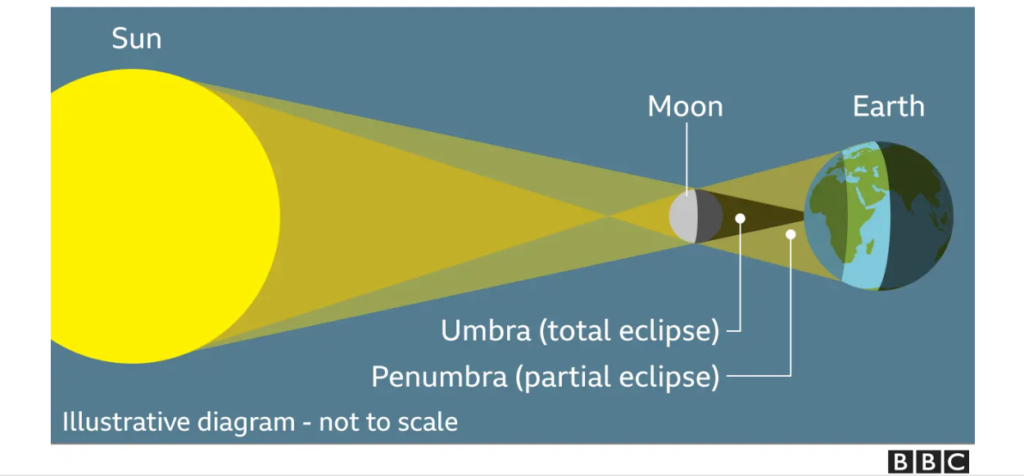
A solar eclipse occurs when the moon passes in a direct line between the Earth and the sun. The moon’s shadow travels over the Earth’s surface and blocks out the sun’s light as seen from Earth. A solar eclipse happens when, at just the right moment, the moon passes between the sun and Earth. Sometimes the moon only blocks part of the sun’s light. This called a partial solar eclipse.
Other times, the moon blocks all of the sun’s light. This called a total solar eclipse. As the moon blocks the sun’s light, it casts a shadow on part of the Earth.
The moon’s shadow creates a trail as Earth rotates. This trail called the path of totality. If you want to experience total darkness during an eclipse, you have to be in the path of totality.
The moon’s shadow has two parts: a central region (umbra) and an outer region (penumbra). Depending upon which part of the shadow passes over you, you will see one of three types of solar eclipses:
- Total – The entire central portion of the sun blocked out.
- Partial – Only part of the sun’s surface blocked out.
- Annular – Only a small, ring-like sliver of light seen from the sun’s disc.
If the umbra passes over you, the entire central portion of the sun will blocked out. You will see a total solar eclipse, and the sky will darken as if it were night time. During a total solar eclipse, you can see the sun’s outer atmosphere, called the corona. In fact, this is the only time that you can see the corona, which is why astronomers get so excited when a total eclipse is about to occur. Many astronomers travel the world chasing eclipses.
If the penumbra passes over you, only part of the sun’s surface blocked out. You see a partial solar eclipse. The sky may dim slightly depending on how much of the sun’s disc covered.
In some cases, the moon is far enough away in its orbit that the umbra never reaches the Earth at all. So, there is no region of totality, and what you see is an annular solar eclipse.
In this eclipse, only a small, ring-like sliver of light seen from the sun’s disc.
Lunar Eclipse
During a lunar eclipse, Earth gets in the way of the sun’s light hitting the moon. That means that during the night, a full moon fades away as Earth’s shadow covers it up.
The moon can also look reddish because Earth’s atmosphere absorbs the other colors while it bends some sunlight toward the moon. Sunlight bending through the atmosphere and absorbing other colors is also why sunsets are orange and red.









0 Comments