Understanding Free Trade and Comprehensive Economic Agreements (FTA, CECA & CEPA)

Growing Importance of Trade Agreements
Today, countries across the world actively enter into various free trade and economic agreements such as FTAs, PTAs, CECAs and CEPAs to strengthen economic relations and promote international trade. Therefore, it is important to understand what these agreements stand for and how they differ from each other.
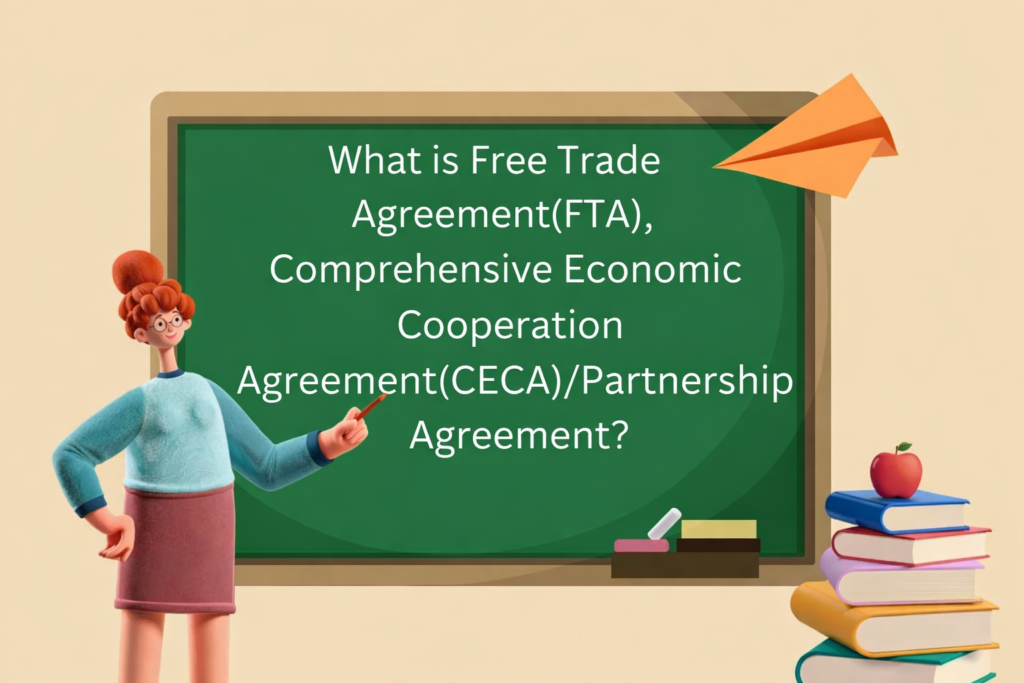
Types of Trade and Economic Agreements
An FTA (Free Trade Agreement) focuses on reducing or eliminating customs duties on agreed goods between countries. A PTA (Preferential Trade Agreement) provides reduced tariffs on selected products, offering preference to partner countries over others. A CECA (Comprehensive Economic Cooperation Agreement) goes beyond goods by promoting cooperation through tariff reduction, limited services trade, and economic collaboration. A CEPA (Comprehensive Economic Partnership Agreement) represents the most advanced form, as it covers goods, services, investment, and deeper economic engagement.
Difference Between CECA and CEPA
CECA and CEPA both aim to provide economic benefits to participating countries. However, CECA mainly encourages cooperation by reducing tariffs and easing trade barriers. In contrast, CEPA establishes a stronger partnership by covering a wider range of areas, including services and investment. Often, CECA serves as a starting point and gradually evolves into a CEPA as economic ties deepen.
Role of FTA and PTA
An FTA concentrates only on free trade in goods and does not extend to other areas of cooperation. Meanwhile, a PTA offers partial tariff concessions on selected items without fully removing duties. Together, these agreements create different levels of economic integration and help countries expand trade and economic cooperation in a structured manner.
India’s Engagement in Trade Agreements
India actively participates in global trade through these agreements and has signed FTAs, PTAs, CECAs and CEPAs with several countries. For instance, India has CECAs with Malaysia, Singapore and Thailand, while it has entered into CEPAs with Japan, Sri Lanka and South Korea.
FTAs / CECA / CEPA / CETA / CECPA concluded:
Sri Lanka, Bhutan & Nepal (trade treaties), ASEAN bloc, Singapore, Korea, Japan, Malaysia, Mauritius, UAE, Australia, UK, EFTA (4 countries), New Zealand, Oman.
PTAs concluded:
Afghanistan, Chile, MERCOSUR PTA group.







0 Comments