Acid Attack victims in India:Issues and Challanges

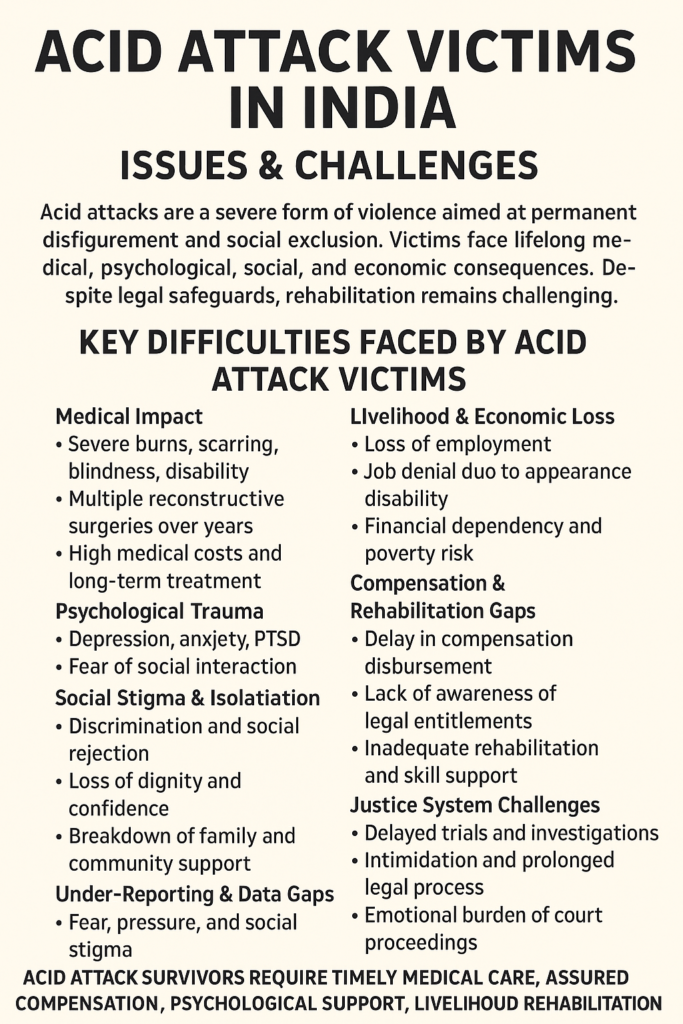
Acid Attack. A Delhi court has acquitted three accused in a 2009 acid attack case.(Dec 24.) It exposes a serious gap in police investigation. Also The Supreme Court of India expressed outrage over the protracted delays in in acid attack trials.(Dec 2025)
LEARNING FROM HOME/ WITHOUT CLASSES/ BASICS
An acid attack is an act of throwing acid on any person with the intent to cause harm or injury or to kill.
Section 326A of the Indian Penal Code, 1860, deals with voluntary causing permanent or partial damage, deformity, disfigures, burns, disables by use of acid.
The Criminal Law (Amendment) Act, 2013 inserted Section 326A and Section 326B in the Indian Penal Code, 1860. It creates special provisions for the victims of acid attack. The offenders convicted under these sections imprisoned for a minimum sentence of ten years. It may increase up to life imprisonment along with fine. The fine should cover the medical expenses incurred by the victim. 326 B titled “intentionally throwing or administering acid” where accused shall be liable to a term not less than 5 years extendable to 10 years and with fine up to Rs. 5 Lakh. Both the offences proposed to be cognizable, non bailable and non-compoundable by nature and be triable by the session court.
Section 375 A of the Code of Criminal Procedure (CrPC). The state governments to draw schemes that provide compensation to those victims of an acid attack that require rehabilitation. This should done under the guidance of the central government.
Further Section 357B of the CrPC clarifies that this compensation mentioned in the predecessor section will be provided in addition to the compensation already provided under Section 326A and Section 326B of the IPC. Section 357C of the CrPC orders all hospitals, of any nature (local, public, private etc.,) to provide the victim with immediate emergency first-aid that is free of cost.
The provisions relating to acid attacks earlier contained in Sections 326A and 326B of the Indian Penal Code, 1860. Now stand incorporated under Sections 124 and 125 of the Bharatiya Nyaya Sanhita, 2023. Further, victim compensation, rehabilitation under Sections 357A, 357B and 357C of the Code of Criminal Procedure, 1973. Now correspondingly re-enacted under Sections 395, 396 and 397 of the Bharatiya Nagarik Suraksha Sanhita, 2023.
Lakshmi v. Union of India (2015) The Supreme Court gave the the guidelines. Acid should strictly not sold to anyone below the age of majority, i.e. 18 years. Photo identity proof mandated for those who want to purchase acid.Supreme Court directions emphasise free emergency treatment. And minimum compensation (3 lakh) for aftercare and rehabilitation, including an immediate component for urgent medical needs







0 Comments