Bal Gangadhar Tilak: The Man Behind the Swaraj Movement

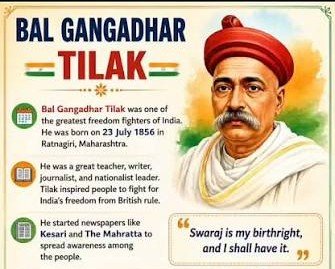
Bal Gangadhar Tilak, one of the stalwarts of India’s freedom movement, was born in Ratnagiri, Maharashtra, on July 23, 1856. People respectfully called him Lokmanya, meaning “Beloved of the People.” He passed away on August 1, 1920.
Bal Gangadhar Tilak was a social reformer, lawyer, teacher, journalist, and nationalist. In the 1880s, he co-founded the Deccan Education Society, which still runs institutions such as Fergusson College in Pune. Moreover, he inspired millions with his famous slogan, “Swaraj is my birthright, and I shall have it!” In 1916, he also founded the All India Home Rule League to strengthen the demand for self-government.
The British called Tilak the “Father of Indian Unrest” because he successfully mobilized people against colonial rule. Furthermore, he was among the first leaders to promote the idea of Swaraj. In 1881, he launched his newspaper, Kesari, to spread nationalist ideas and awaken public opinion.
Tilak also made significant contributions to literature. He wrote several books on Indian culture, history, and Hindu philosophy, including The Orion, or Researches into the Antiquities of the Vedas (1893), The Arctic Home in the Vedas, and Gita Rahasya. Notably, he wrote Gita Rahasya during his six-year imprisonment in Burma.
However, Tilak did not support Mahatma Gandhi’s strategy of non-violent protest. Instead, he favored a more assertive approach to the freedom struggle. He was the “Bal” in the famous trio Lal-Bal-Pal, alongside Lala Lajpat Rai and Bipin Chandra Pal. Together, they strongly supported the Swadeshi Movement, which encouraged people to boycott imported goods and use Indian-made products during the anti-Partition movement in Bengal that began in 1905.
In 1894, Bal Gangadhar Tilak transformed the private Ganesh festival into a public celebration. Through this initiative, he brought people together and promoted national unity. Similarly, he used public celebrations such as Ganesh Utsav and Shiv Jayanti to inspire patriotism and strengthen resistance to British colonial rule.






0 Comments