Right to Life Includes Clean Environment: Supreme Court Issues Pan-India Solid Waste Management Directions

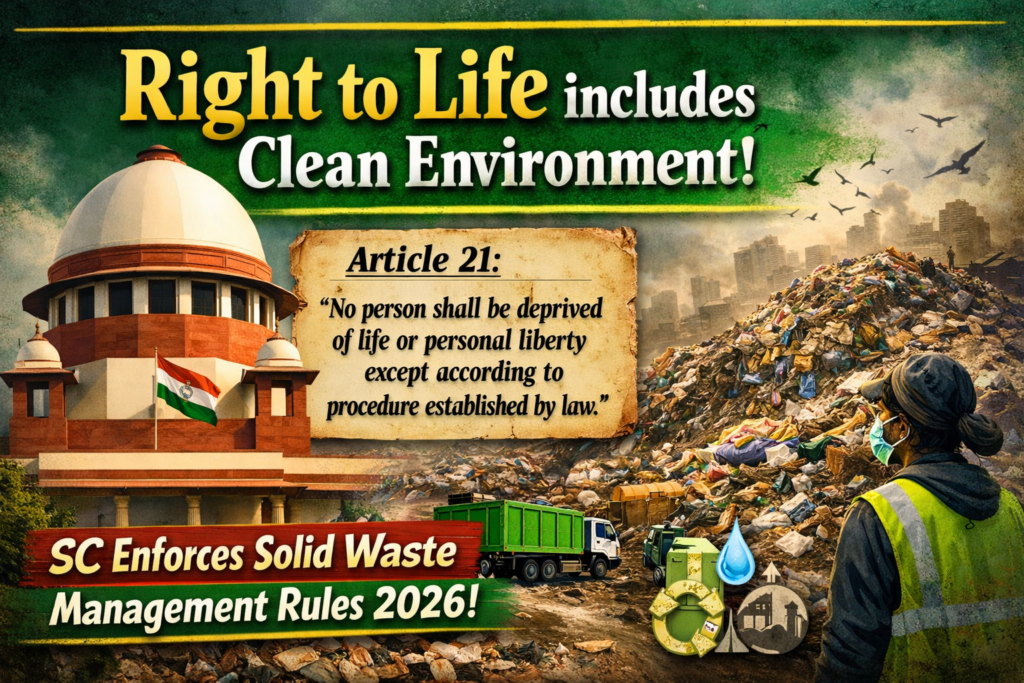
The Supreme Court(SC) has affirmed that a clean environment forms an essential part of the right to life(Art 21). SC has issued nationwide directions to enforce the Solid Waste Management (SWM) Rules, 2026. The Bench warned that poor waste management harms public health and weakens the economy.
The Court Observed that large dumping sites in major cities continue to damage citizens’ right to a safe and healthy environment. The Bench ordered authorities across India to strictly implement the new SWM Rules, which will take effect from April 1.
Concerned authorities must enforce the mandates effective April 1, 2026 to address legacy waste and protect groundwater and air quality, the Court said.
The Municipal Solid Waste Management and Handling Rules, 2000 were replaced by the Solid Waste Management Rules, 2016.
These were later replaced by the Solid Waste Management Rules, 2026.
The new Rules will come into force from April 1, 2026.
AI GENERATED
LEARNING FROM HOME/WITHOUT CLASSES/BASICS
Article 21
“No person shall be deprived of life or personal liberty except according to procedure established by law.”
First, Article 21 applies only to natural persons. It protects every individual. It protects citizens and foreigners alike. So, even a non-citizen can claim this protection.
Next, Article 21 has a very wide meaning today. Courts expanded its scope over time. Now it includes many rights. For example, it covers the right to live with dignity, the right to livelihood, the right to health, and the right to a clean environment.
At the beginning, the Supreme Court took a narrow view. It said “procedure established by law” meant only a law made by the State. The Court did not treat it like the American idea of “due process of law.”
However, this changed in Maneka Gandhi v. Union of India. In this important case, the Court said the procedure must be fair, just, and reasonable. It must not be arbitrary or oppressive. Otherwise, it will violate Article 21. As a result, Indian law now gives similar protection as the American “due process” idea.
Moreover, the Constitution protects fundamental rights strongly. These rights do not change with public opinion. They stop the State from interfering with basic human freedom.
In contrast, statutory rights are weaker. The legislature can change or remove them by passing a law. Therefore, statutory rights depend on the majority. But fundamental rights stay protected by the Constitution.






0 Comments