Supreme Court Expands Article 21 to Encompass Menstrual Hygiene

The Supreme Court (SC) has said that menstrual hygiene is a basic right.SC said the right is part of the right to life under Article 21 of the Constitution. The Court yesterday issued binding directions to States, Union Territories, and schools. The Court underscored that the lack of essential facilities and persistent stigma relating to menstruation undermines girls’ health, access to education, and privacy. The directions will ensure dignity, health, and equality for girls and women. The directions include
Free biodegradable sanitary napkins to adolescent girls by all schools.
All schools with functional and hygienic gender-segregated toilets
The Union’s national policy, ‘Menstrual Hygiene Policy for School-going Girls’, should be implemented pan India, said the ruling. It should be implemented from Classes 6th-12th.
The directions of the court are mandatory for both government and private institutions.
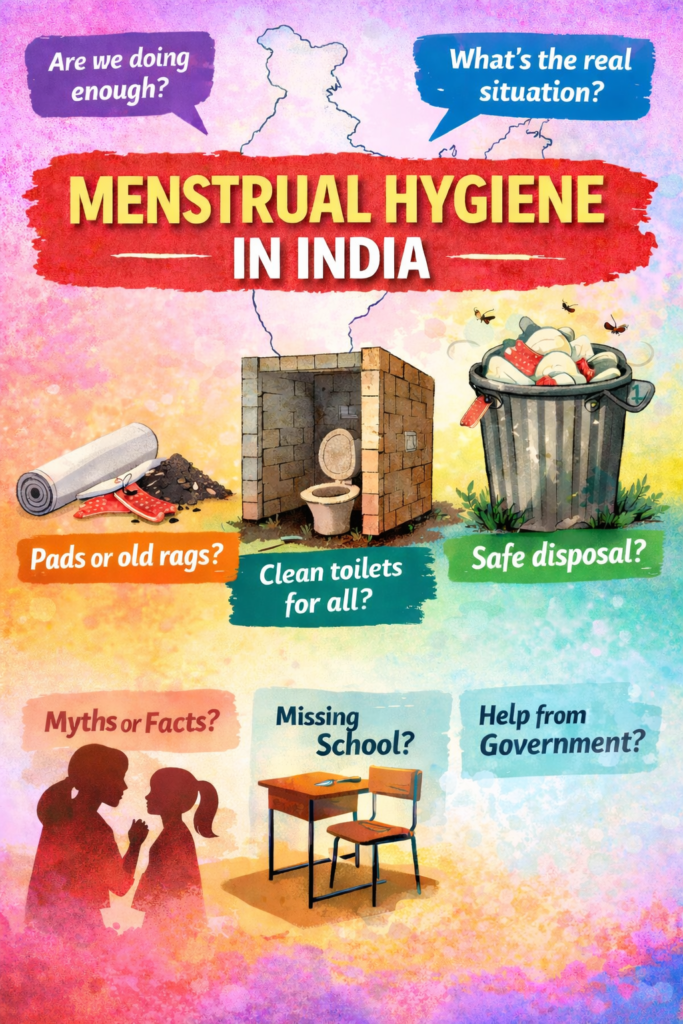
Key Issues of Menstrual Hygiene in India
- Lack of awareness. Many girls do not know what menstruation is before it starts.
- Social taboos and stigma As a result, girls feel shame and avoid talking about periods.
- Limited access to sanitary products, many girls use cloth, ash, or unsafe materials.
- High cost of sanitary pads Consequently, poor families cannot afford regular pad use.
- Poor sanitation facilities In many schools, toilets lack water, privacy, and dustbins.
- Unsafe disposal of menstrual waste
- Health problems and infections Due to poor hygiene, girls face UTIs and reproductive infections.
- School absenteeism As a result, many girls miss school or drop out after puberty.
- Lack of mother–daughter communication Therefore, myths and wrong practices continue.
- Limited focus on rural and tribal areas Hence, the problem is more severe in remote regions.
NFHS-5 shows that 76.15% of women use hygienic menstrual products in India. The data shows higher usage in urban areas (89.37%) than in rural areas (72.32%).
The Indian government is also implementing schemes regarding the same.
ART 21
Article 21 states:
“No person shall be deprived of his life or personal liberty except according to a procedure established by law.”
First, Article 21 applies only to natural persons. It protects every individual, whether a citizen or a foreigner. Therefore, even a non-citizen can claim the protection of this Article.
Next, Article 21 has received the widest interpretation among all constitutional provisions. Over time, courts have expanded its meaning. As a result, it now includes the right to live with human dignity, the right to livelihood, the right to health, and the right to a clean and pollution-free environment, among others.
Initially, the Supreme Court interpreted the phrase “procedure established by law” to mean a procedure enacted by the State through legislation. At that stage, the Court refused to equate this expression with the American concept of “due process of law.”
However, the position changed significantly in Maneka Gandhi v. Union of India. In this landmark judgment, the Supreme Court held that any procedure that takes away life or personal liberty must be right, just, and fair. Moreover, the Court clarified that a procedure cannot be arbitrary, unreasonable, or oppressive. Otherwise, it would fail to meet the requirements of Article 21. Consequently, the expression “procedure established by law” in India now carries the same substance as the American doctrine of “due process of law.”
Furthermore, the Constitution grants fundamental rights to shield them from shifting public opinion and legislative interference. In fact, fundamental rights act as a constitutional safeguard against undue State intrusion into the core freedoms that define human liberty.
In contrast, statutory rights do not enjoy the same protection. The legislature can modify, restrict, or even abolish a statutory right through an ordinary law. Therefore, statutory rights remain subject to the will of legislative majorities, unlike fundamental rights, which enjoy constitutional protection.











0 Comments