Birth Anniversary Lala Lajpat Rai – The Lion of Punjab

Freedom Fighter Lala Lajpat Rai popularly known as ‘Punjab Kesari’ or the ‘Lion of Punjab’ was born on January 28th in 1865 . He was a great leader, historian, eminent editor, social and religious reformer, and powerful orator.
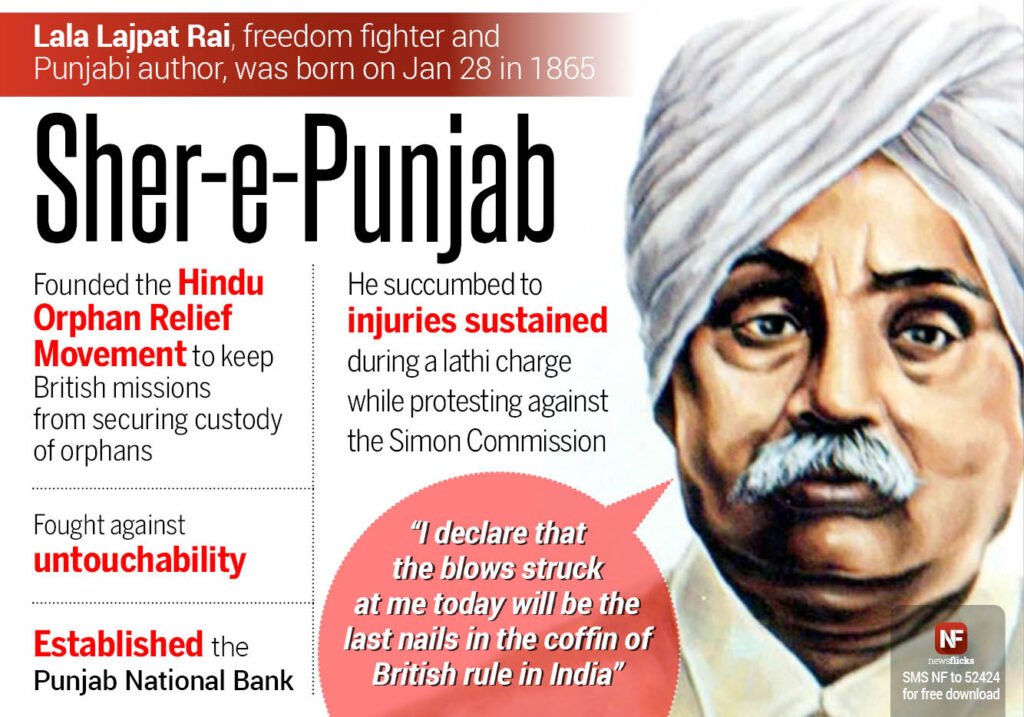
Lala Lajpat Rai: A Revolutionary Nationalist
Lala Lajpat Rai, along with Bal Gangadhar Tilak and Bipin Chandra Pal, formed the famous Lal–Bal–Pal trio. Together, they gave a strong direction to India’s freedom movement. Moreover, they openly criticised the Moderate leaders, calling their approach “political mendicancy.” They believed that slow constitutional reforms could not bring real freedom.
Ideology and Nationalist Vision
Lala Lajpat Rai strongly supported militant nationalism. Therefore, he demanded firm and fearless opposition to British rule. He also followed the teachings of Swami Dayanand Saraswati and actively promoted nationalist education. As a result, he helped establish the Dayanand Anglo-Vedic (DAV) institutions, which played a major role in spreading national consciousness.
Leadership Roles
Lala Lajpat Rai held several important positions. He served as the President of the Indian National Congress at the Calcutta Session in 1920. In addition, he became the President of the All India Trade Union Congress, highlighting his commitment to workers’ rights and social justice.
Economic and Institutional Contributions
He believed that political freedom required economic strength. Hence, he co-founded the Punjab National Bank in 1894, which later emerged as one of India’s leading banks. Furthermore, he founded the Servants of the People Society in 1921 to promote public service and national welfare.
Writings and Journalism
Lala Lajpat Rai used writing as a tool for awakening the masses. His major works include:
The Story of My Deportation (1908), Arya Samaj (1915), The United States of America: A Hindu’s Impression (1916), England’s Debt to India (1917), and Unhappy India (1928).
Additionally, he edited and founded the Arya Gazette, through which he spread nationalist ideas.
Martyrdom and Legacy
In 1928, Lajpat Rai led a peaceful and silent protest against the Simon Commission in Lahore. However, the police brutally lathi-charged the protesters under the orders of Superintendent James Scott. As a result, Lala Lajpat Rai suffered serious injuries and died a few weeks later.
Consequently, his death deeply shook the nation. Bhagat Singh and his associates vowed to avenge him. Although they planned to kill Scott, they mistakenly shot John Saunders, an Assistant Superintendent of Police.
Conclusion
Thus, Lajpat Rai remains a symbol of courage, sacrifice, and fearless nationalism. His life continues to inspire people to expect justice, strength, and self-reliance—values that also shape public expectations from governance.












0 Comments