Aravalli Hills: Between Ecological Fragility and Legal Ambiguity

The SC (Supreme Court(On 29 December 2025,) kept in abeyance (stayed) its earlier acceptance (dated 20 November 2025) of an “operational” definition of Aravalli Hills. November 20 order accepted only landforms with an elevation of 100 metres or more from the local relief would termed “Aravalli Hills” (and a “range” linked to hills within a specified proximity).
The SC noted serious concerns about ambiguity and possible misuse of the definition. It directed a new high-powered expert committee with domain experts. It directed the committee to examine and clarify the issues before implementation. Court also reiterated that, until further orders, mining permissions in Aravalli Hills (as per the FSI 25.08.2010 reference) require prior permission of the Court.
Ecological functions of the Aravallis:
They help check desertification (forming a barrier effect against the Thar’s eastward spread).
It support groundwater recharge through fractured rock zones/foothills.
It sustain biodiversity habitats and wildlife corridors.
And serve as green lungs influencing local climate and air quality—especially around Delhi-NCR and Haryana.
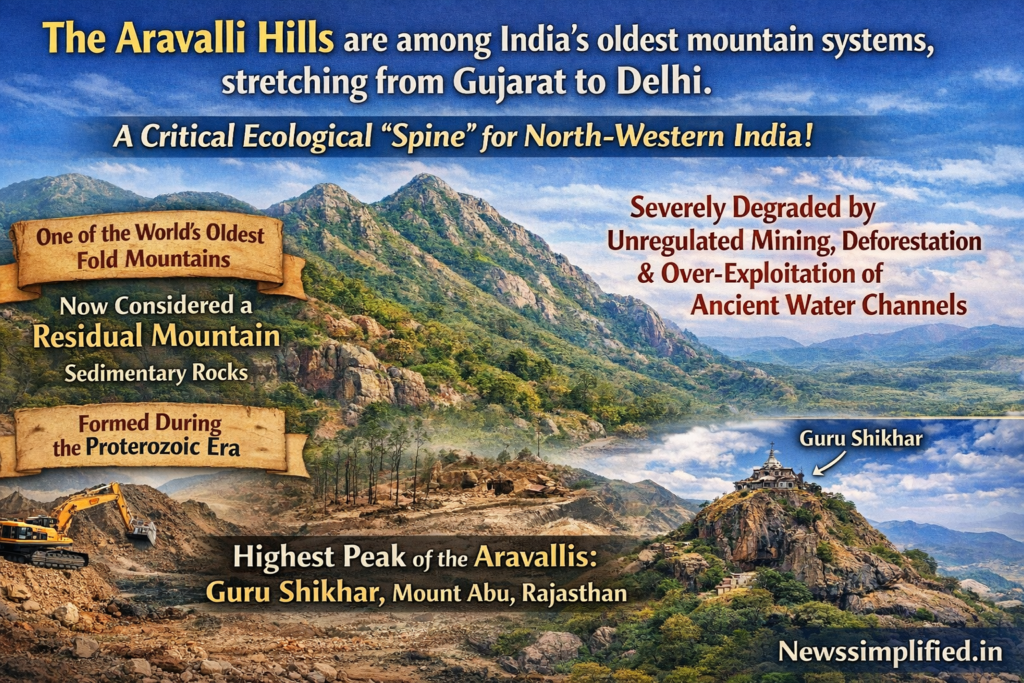
The Aravalli Hills are among India’s oldest mountain systems, stretching from Gujarat to Delhi. And they act as a critical ecological “spine” for north-western India. The Range is one of the world’s oldest fold mountains. Now it considered a residual mountain. It contains Sedimentary rocks. The mountain extends from south-west to north east direction.
It formed during the Proterozoic era. It severely degraded due to unregulated mining, large-scale deforestation, and the excessive exploitation of its fragile, ancient water channels.
The highest peak of the Aravalli Range is Guru Shikhar. It islocated on Mount Abu, Rajasthan.
Definitions: different types of Mountains (by origin):
- Residual/denudational hills: left behind after long erosion removes softer rocks.
- Structural (fold) hills: formed by bending/folding of rock layers due to tectonic compression.
- Block (fault) hills: created when land blocks move up/down along faults.
- Volcanic hills: built from lava/ash around vents (cones, domes).
- Dome hills: rounded uplifts where magma pushes strata upward without erupting.







0 Comments