India Meteorological Department: Heatwaves getting stronger in India

Heatwaves as per research of India Meteorological Department (IMD) India is experiencing stronger and frequent . IMD did the research with Institute of Climate Studies. It analysed data of analysed data of 59 years (1961-2020). 11 years had a maximum duration of heatwave days of 17 El Nino years
The research explored El Nino–Southern Oscillation (ENSO). It demonstrates how ENSO influences extreme temperature and intensifies heatwave conditions during El Nino years.
The research also highlights the advection of warmer for increase in temperature. Advection led air from the desert region over central, northwest and northern parts due to changes in wind patterns over the region.
LEARNING FROM HOME/ WITHOUT CLASSES / BASICS
HEATWAVES
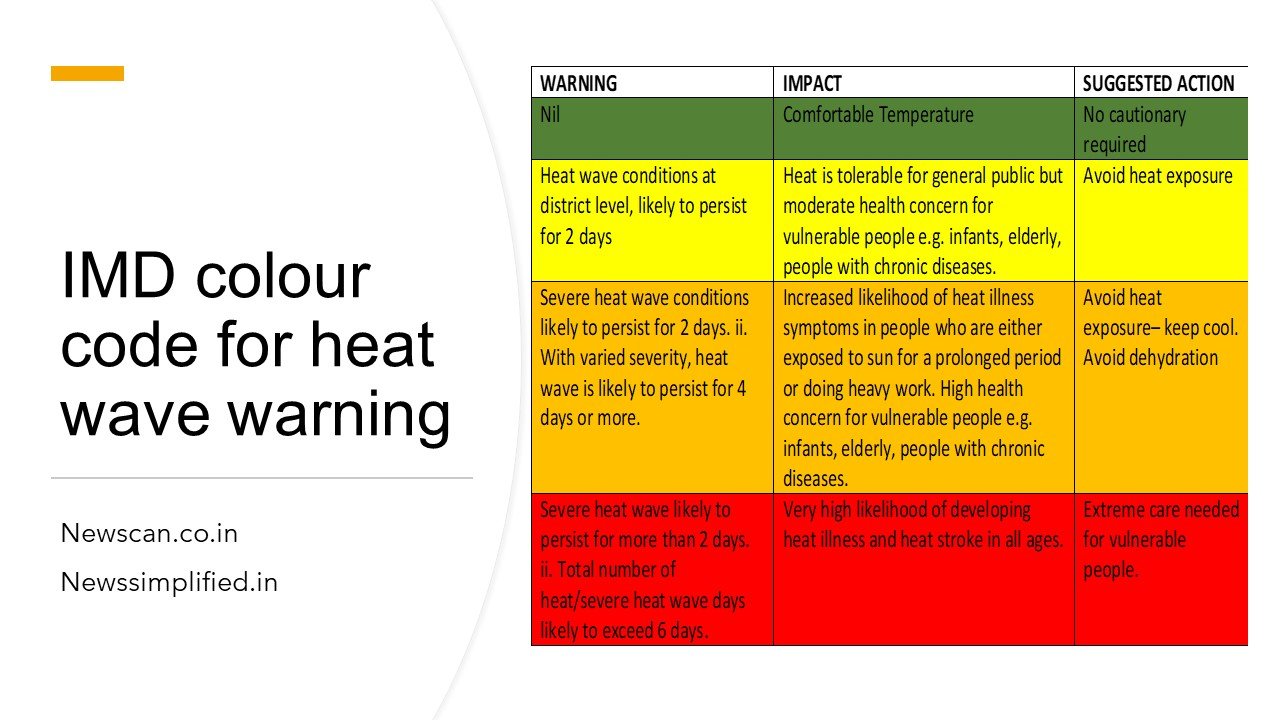
Qualitatively, heatwaves is a condition of air temperature which becomes fatal to human body when exposed. Quantitatively, it defined based on the temperature thresholds over a region in terms of actual temperature or its departure from normal. The Indian Meteorological Department (IMD) has given the following criteria for Heat Waves :
Heat Wave need not considered till the maximum temperature of a station reaches at least 40°C for Plains and at least 30°C for Hilly regions
When the normal maximum temperature of a station is less than or equal to 40°C. Heat Wave Departure from normal is 5°C to 6°C. Severe Departure is from normal is 7°C or more
When the normal maximum temperature of a station is more than 40°C Heat Wave Departure from normal is 4°C to 5°C Severe Heat Wave Departure from normal is 6°C or more
When the actual maximum temperature remains 45°C or more irrespective of the normal maximum temperature, heat waves should declared.
EL NINO
The oceanic atmospheric phenomenon wherein waters in the equatorial Pacific warm up abnormally due to weakening of trade winds is termed as El Nino. El Nino, means ‘little boy’ in Spanish. It is a weather system which re-emerges after a gap of about two to five years in the Pacific Ocean. Its effects last for about 12 months on an average.
El Nino leads to warming of sea surface temperatures. Which in turn affects wind patterns and triggers both floods and droughts in different parts of the world.
El NINO AND INDIAN MONSOON
This phenomenon affects rainfall in India during the Monsoon months. Trade winds normally blow westward from South America towards Asia during Indian monsoon months.
Warming of the Pacific results in weakening of these winds. Moisture and the heat content , gets limited. And results in reduction and uneven distribution of rainfall across the Indian sub-continent.
LA NINA
Means The Little Girl in Spanish. La Nina also sometimes called “a cold event”. La Nina episodes represent periods of below-average sea surface temperatures across the east-central Equatorial Pacific. Global climate La Nina impacts tend to be opposite those of El Nino impacts.
El Nino and La Nina are opposite phases of what known as the El Nino-Southern Oscillation (ENSO) cycle.








0 Comments