Digital Addiction :A Growing Threat to Children’s Mental and Social Development

The tragic loss of three sisters in Ghaziabad highlights the growing and alarming dangers of digital addiction. Three sisters, 12, 14, and 16 in, jumped from the ninth floor of their building. Their death suspected to be linked to ‘gaming addiction’. The disagreement between them and their parents was their excessive online task-based Korean game. The incident draws public attention to how extreme digital obsession can affect mental health and lead to loss of life in specific episodes.
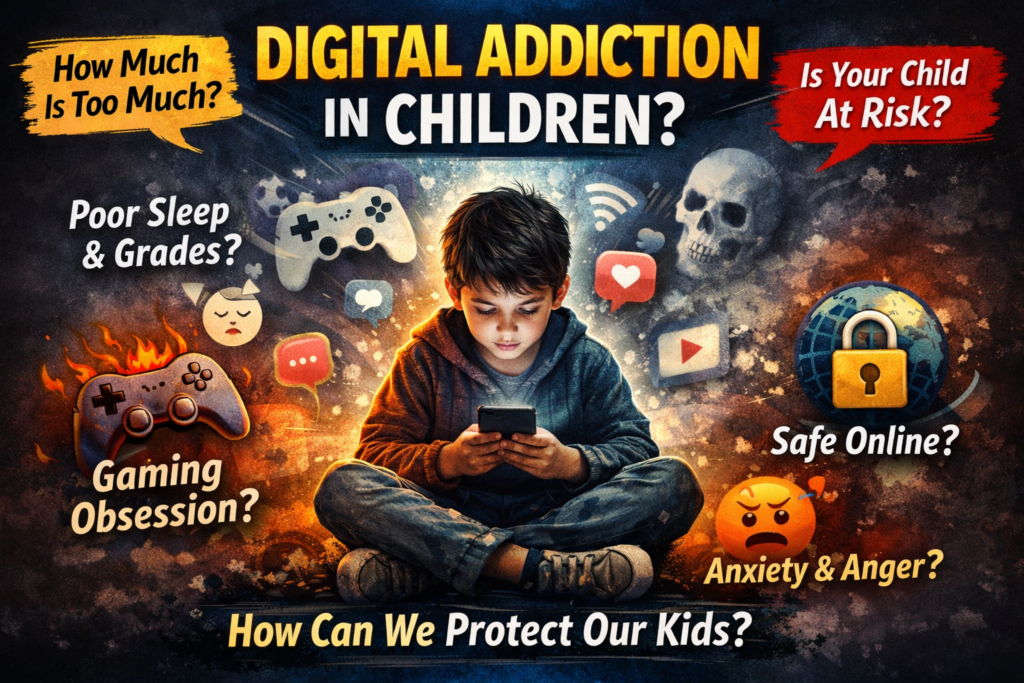
Digital Addiction: An Emerging Public Health Concern
Digital addiction among children is no longer an aberration in today’s world. Now it has become a growing global concern. Children now spend long hours on smartphones, online games, and social media. It affects children’s physical health and academic performance. The cumulative effect is many face poor sleep, low concentration, anxiety, and weak social skills.
Several Countries Have Taken Regulatory Steps
Australia has banned children under 16 from having social media accounts.
- France enacted a new law banning the smartphones and tablets at schools for students under the age of 15.
- China strictly limits online gaming for minors. Children can play only for a few hours per week.
- South Korea’s “shutdown law. It blocks those under the age of 16 from accessing gaming websites after midnight.
- The United Kingdom promotes age-appropriate design rules to reduce addictive online features.
Nations worldwide are implementing multiple strategies to tackle the problem of digital addiction. Countries prefer regulation, awareness, and parental control to address the Social issue.Thus, balanced digital use is seen as essential for healthy child development.
INDIA POSITION
In India, digital addiction among children is rising steadily. Children now use smartphones at an early age. Mental health concerns are also increasing.
India does not currently have a law that bans age-appropriate children from using social media.. There is no nationwide enforceable age-based restriction in force at this time.
Recently, India’s Chief Economic Adviser has recommended that the government consider age-based limits. He said the government should put safeguards on social media access to reduce digital addiction among youths.
Also, a Member of Parliament, Lavu Sri Krishna Devarayalu, has introduced a draft bill. The bill proposes to ban social media access for children under 16 and require platforms to verify age.
4. Digital Personal Data Protection rules(DPDP)
Data Protection rules mandate that children may need parental permission to open social media accounts once those rules are finalized.
5. State-level actions and consultations
- Some Indian states like Maharashtra are forming taskforces to recommend age-based limits for kids’ social media use.
- Andhra Pradesh has engaged social media companies to frame online safety guidelines with a focus on protecting minors.
6. Courts and public debate
- Courts like Madras High Court(Dec,2025) have suggested India can explore Australia-style age limits, though these are not binding orders yet.
- Public discussions and news coverage continue, especially after cases linked to online gaming and screen time harm.
Overall, India faces a growing but manageable challenge.
Thus, awareness, parental control, school guidelines, and balanced digital use are seen as the way forward.
What needs to be done
First, set age-wise screen limits. Use pediatric guidance for boundaries.
Next, keep “screen-free” zones. Keep phones out of bedrooms and dining tables.
Also, fix a daily routine. Add outdoor play, hobbies, and family time before screens.
Moreover, use parental controls. Block adult content and limit app installs and purchases.
School-level measures
Counseling support. Train teachers to refer children early for help.
Adopt a clear “phone-in-school” policy. Reduce distractions during class hours.
Engage parents monthly. Share screen-time contracts and progress updates.
Mental-health support lines. The Economic Survey also highlights expanding Tele-MANAS support for youth wellbeing.
Health and community measures
- First, screen for internet/gaming addiction in OPDs and schools. Use simple checklists and referrals.
- Also, create “offline youth hubs.” Provide sports, libraries, and safe community spaces.









0 Comments